Skills Verification Crisis: How to Validate Talent Without Traditional Degrees
Why the shift to competency-based hiring is stalling without reliable ways to verify what talent actually knows

📌 In a nutshell:
Organisations have committed to hiring based on skills rather than degrees, but lack the infrastructure to verify those skills—creating a trust crisis that threatens to collapse the entire skills-first movement
The labour market has reached a paradoxical inflection point. Skills-first hiring has moved from aspiration to mainstream practice, yet a fundamental infrastructure problem threatens to undermine the entire movement: verification. Whilst organisations have embraced the rhetoric of skills-based talent practices, they lack reliable mechanisms to validate those skills at scale. The result is a trust crisis that could derail one of the most important workforce transformations in decades.
What you will learn from this article:
Why skills-first hiring has stalled despite widespread adoption
How the trust gap undermines talent transformation
Why traditional credential systems cannot adapt to modern workforce dynamics
The hidden verification crisis in internal mobility
How artificial intelligence creates as many verification problems as it solves
What must happen now to prevent retreat to outdated proxies
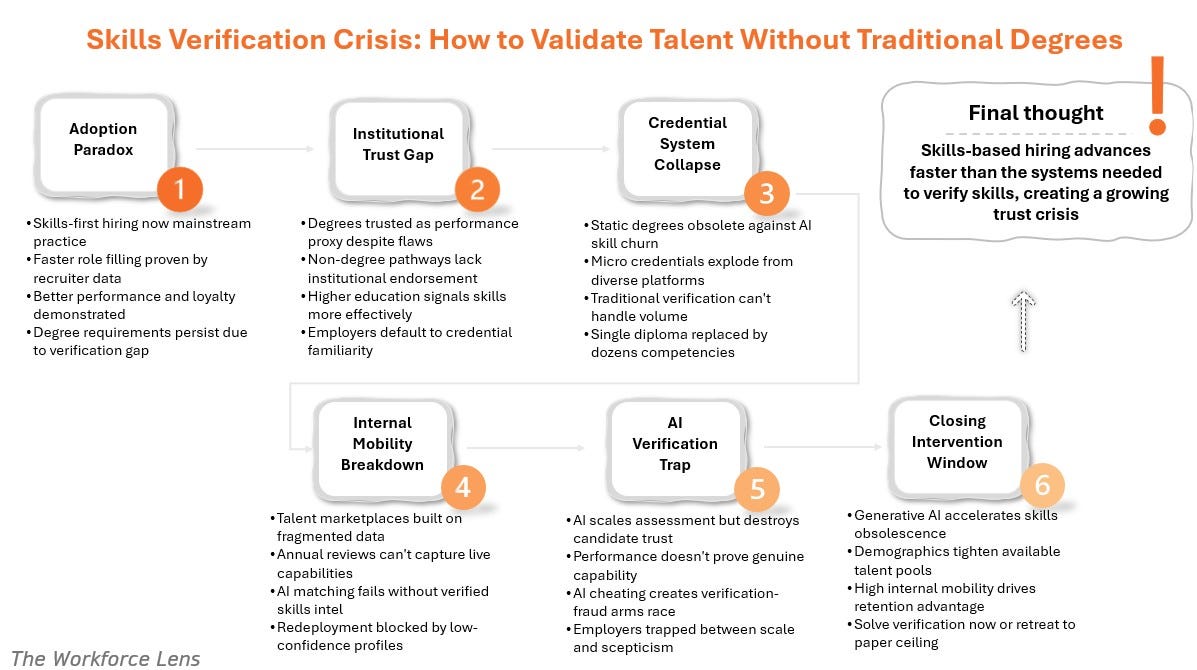
Table of contents:
The Paradox of Adoption Without Infrastructure
The Institutional Credibility Deficit
The Structural Obsolescence of Credential Systems
Verification Challenges Within Organisational Boundaries
Technological Solutions and Their Inherent Contradictions
Alternative Verification Architectures
The Narrowing Window for Systemic Reform
Strategic Priorities for Talent Leadership
Final Thoughts: Building Infrastructure for Capability-Based Economies
Key takeaways
Next on The Workforce Lens
Further reading
The Paradox of Adoption Without Infrastructure
Research from the Organisation for Economic Co-operation and Development reveals that skills-first approaches are rapidly gaining traction across member nations. LinkedIn’s data shows that recruiters using skills-based filters fill roles faster than those relying on traditional credential searches. This marks a fundamental shift in how employers discover talent, driven by acute labour shortages and the accelerating pace of technological change.
The business case appears compelling. Analysis by BCG and Lightcast of more than 20 million job postings demonstrates that skills-based hires perform comparably to traditional hires in promotion rates whilst showing greater loyalty to their employers. Meta-analyses in industrial and organisational psychology have long demonstrated that work sample tests and skills assessments substantially outperform educational credentials in predicting job performance.
Yet beneath these promising statistics lies a troubling reality. According to the World Economic Forum’s Future of Jobs Report 2025, fewer than 20 per cent of employers have removed degree requirements to expand talent pools. The OECD identifies validation and verification of skills as a critical barrier, noting that “unequal access to digital tools, challenges in validating skills, and employers’ reluctance to trust non-traditional credentials” remain significant obstacles to adoption.
💡 Related read:
“Transform Your Talent Strategy: Align Workforce Capabilities for Sustainable Business Growth”
Discover how to shift from outdated talent models to skills-based, data-driven strategies that align workforce capabilities with business goals, ensuring agility, resilience, and sustainable growth in a fast-changing world.
The Institutional Credibility Deficit
The verification crisis manifests in multiple dimensions. At its core sits a fundamental question: without the proxy of an institutional credential, how do employers know whether candidates truly possess claimed skills?
The OECD’s research reveals significant disparities in how individuals signal their capabilities. Those with higher educational credentials demonstrate substantially more skills on professional platforms compared to those with less formal education. However, this disparity reflects not actual skills differences but rather differential access to validation mechanisms. Those with traditional credentials benefit from institutional endorsement; those who acquired skills through alternative routes face a systematic disadvantage in demonstrating competence.
Educational attainment remains strongly correlated with skills signalling precisely because degree-granting institutions provide trusted verification. According to Credential Engine’s Counting Credentials report, there are over 1.1 million unique educational credentials in the United States alone. This sprawling and unregulated credentialing landscape creates significant challenges for employers and learners, as highlighted in Credential Engine and U.S. Department of Commerce initiatives referencing standardisation frameworks.
The World Economic Forum notes that standardised frameworks and taxonomies can strengthen clarity in skills signalling, yet adoption remains fragmented. Without common language and validation infrastructure, skills data becomes difficult to interpret and compare across contexts.
The Structural Obsolescence of Credential Systems
The inherited verification infrastructure was designed for a world of stable credentials issued by established institutions. Universities, professional bodies, and licensing organisations provided trusted validation that employers could rely upon. This system worked adequately when most positions required formal credentials and technological change proceeded gradually.
Three fundamental shifts have rendered this model inadequate:
First, skills demands now evolve at unprecedented speed. The World Economic Forum’s Future of Jobs Report 2023 found that approximately 60 per cent of workers will require additional training by 2030 to keep pace with skills demands driven by artificial intelligence adoption. The OECD documents rising demand for management skills and business process capabilities in occupations exposed to AI disruption. When credentials become obsolete within years or even months, static degrees certified decades ago provide limited signal of current capability.
Second, the volume and diversity of skill-building pathways has exploded. The OECD documents how microcredentials, online courses, and workplace training have scaled to reach workers of all backgrounds, particularly those in vulnerable groups or at-risk industries. This democratisation of learning creates opportunity but also verification complexity. Traditional registrar-based systems cannot efficiently process thousands of credentials monthly, especially when they emanate from diverse platforms using different formats and standards.
Third, the verification burden has shifted from institutions to individual employers. BCG’s analysis found that skills-based job advertisements specify a substantially larger number of required competencies compared to traditional job postings for the same roles. This specificity helps matching but multiplies verification requirements. Employers must now assess dozens of discrete competencies rather than relying on a single institutional endorsement.
Verification Challenges Within Organisational Boundaries
The verification crisis extends beyond external hiring into internal talent management. Organisations have increasingly implemented talent marketplace platforms to facilitate internal mobility and better deploy existing skills. Industry research suggests that a substantial proportion of large enterprises are implementing AI-powered talent marketplace features.
Yet these initiatives face the same fundamental challenge: how to accurately capture and verify employee capabilities at scale. According to Betterworks’ 2024 Skills Fitness Report, approximately 70 per cent of HR professionals rely on performance evaluations to assess skills. However, many organisations conduct reviews only annually or semi-annually, rendering skills data quickly outdated in fast-changing environments.
PwC’s implementation of its “My Marketplace” talent platform illustrates both the opportunity and the challenge. The system uses artificial intelligence to match employees with opportunities based on their skills, yet its effectiveness depends entirely on the quality and currency of underlying skills data.
The cost of inaccurate skills data extends beyond poor matching. Research from consulting firms indicates that internal redeployment can substantially streamline time-to-fill metrics and reduce costs compared to external hiring. However, these benefits materialise only when organisations have verified intelligence about employee capabilities.
Technological Solutions and Their Inherent Contradictions
Artificial intelligence presents both potential solution and new risk. On one hand, AI-powered assessment tools could enable scalable skills verification. IBM’s 2024 AI Adoption Index shows that a substantial proportion of organisations are actively using or exploring AI capabilities, with many implementing assessment features.
These systems can evaluate technical skills in real-time through simulations, analyse communication patterns in video interviews, and benchmark capabilities against role requirements. Various assessment technology providers have reported improvements in hiring efficiency and candidate diversity compared to traditional evaluation methods.
However, AI verification introduces its own trust challenges. According to Gartner research, only 26 per cent of applicants trust AI to evaluate them fairly. UNESCO warns that unmonitored verification algorithms can replicate existing inequalities in global education systems, potentially favouring prestigious institutions over demonstrated proof of capability.
The fundamental question remains: can AI verify skills more reliably than existing mechanisms? Whilst AI can assess performance on specific tasks, determining whether that performance represents genuine capability versus memorisation or assistance remains problematic. The rise of AI-augmented job applications and assessment completion further complicates verification, creating an arms race between AI-powered skill demonstration and AI-powered fraud detection.
Alternative Verification Architectures
Several technological approaches attempt to address the verification crisis, though none has yet achieved widespread adoption:
Blockchain-based credentials offer tamper-proof verification through distributed ledgers. Recent academic studies in journals such as Scientific Reports and IEEE Access explore how blockchain systems can ensure academic credential integrity through decentralised storage and immutability. MIT’s Media Lab developed Blockcerts, an open infrastructure for issuing and verifying academic credentials on the Bitcoin blockchain, enabling anyone to verify certificate authenticity without relying on the issuer.
However, blockchain adoption faces significant barriers. Academic research on blockchain credential systems identifies challenges including safeguarding privacy, managing cryptographic keys, and ensuring wide institutional adoption. The technology requires substantial infrastructure investment and coordination amongst multiple stakeholders.
Verifiable Credentials, based on W3C standards, provide another approach. Jobs for the Future’s research on verifiable credentials, published in their 2024 report “Building Trust in Skills-Based Hiring,” highlights how these open standards can address trust issues whilst enabling credential portability across systems. Credential Engine and the Digital Credentials Consortium have released frameworks for issuer identity registries, establishing infrastructure to confirm whether credentials emanate from trusted sources.
AI-driven verification platforms represent a third approach. These systems extract and validate skills data from multiple sources including transcripts, employment records, and portfolios. However, their effectiveness depends on the quality of underlying data and their ability to distinguish authentic capability from inflated claims.
The Narrowing Window for Systemic Reform
The verification crisis will intensify in 2026 for several reasons:
First, generative AI is accelerating both skills obsolescence and the need for verification. OECD reports highlight artificial intelligence’s substantial impact across numerous occupations and the growing need for adaptive skills. The World Economic Forum projects that analytical thinking skills, resilience, flexibility, and technical capabilities will see surging demand. Organisations must verify these emerging competencies without established assessment infrastructure.
Second, demographic pressures are mounting. Many OECD countries face ageing workforces with retirements outpacing new talent development in specialised sectors. This scenario amplifies the imperative for skills-based hiring to expand talent pools, but only if verification mechanisms inspire employer confidence.
Third, internal mobility has become a strategic priority. LinkedIn’s 2023 Workplace Learning Report found that employees with higher internal mobility stay with organisations for an average of 5.4 years, compared to 2.9 years in low-mobility organisations. However, enabling internal movement requires sophisticated skills intelligence that most organisations lack.
Fourth, employee expectations have evolved. The OECD found that around four in ten adults across member countries engage in formal or non-formal learning for job-related reasons. These individuals need mechanisms to demonstrate newly acquired capabilities to current and prospective employers.
Strategic Priorities for Talent Leadership
The verification crisis demands immediate attention from talent leaders. The OECD’s policy recommendations emphasise several priorities:
Organisations must invest in clear, standardised systems for recognising and verifying skills. This requires moving beyond self-reported competencies toward validated assessments, whether through testing, simulations, portfolio reviews, or verified project outcomes.
Employers need robust skills taxonomies that enable consistent skill definition across the organisation. BCG’s research emphasises that skills-based job advertisements must specify needed competencies clearly. However, clarity means nothing without accompanying verification mechanisms.
Integration with learning systems must improve. The OECD advocates for lifelong learning infrastructure that continuously validates skill development. This means connecting assessment, learning, and verification in seamless workflows rather than treating them as discrete events.
Collaborative approaches to verification show promise. When employers, educational institutions, and technology providers establish shared standards and infrastructure, verification becomes more reliable and less redundant. The World Economic Forum’s Global Skills Taxonomy Adoption Toolkit exemplifies this collaborative model.
Final thoughts:
Skills-first hiring represents necessary evolution in talent practices, driven by technological change, demographic shifts, and the imperative for organisational agility. The business case is sound: skills-based hires perform well, stay longer, and expand talent pools. However, the movement has progressed faster than the infrastructure needed to support it.
The verification crisis of 2026 stems from a fundamental mismatch between aspirations and capabilities. Organisations have committed to evaluating talent based on competencies yet lack reliable mechanisms to validate those competencies at scale. Traditional credential verification cannot handle the volume, diversity, and dynamism of modern skills development. Emerging technologies offer promise but face adoption barriers and trust challenges of their own.
This is not a technological problem alone. It requires new collaborative infrastructure, shared standards, and cultural shifts in how organisations approach talent verification. Employers must move beyond proxy signals toward validated assessment. Educational providers must issue verifiable, portable credentials. Technology platforms must enable secure, privacy-preserving verification across systems. Workers must have tools to demonstrate capabilities accumulated through diverse pathways.
The stakes extend beyond hiring efficiency. The verification crisis affects opportunity and equity. As BCG’s research demonstrates, skills-based hiring can tear down the “paper ceiling” that excludes capable individuals from opportunity based on formal credentials. However, this potential realises only when verification systems inspire confidence whilst remaining accessible.
The organisations that solve verification will gain significant competitive advantage in talent acquisition and development. Those that ignore the problem will find their skills-first initiatives undermined by persistent doubts about candidate capabilities. 2026 will clarify which path the labour market takes: toward genuine skills-based opportunity, or back toward proxy credentials that everyone understands how to verify but that increasingly fail to predict performance.
The choice belongs to talent leaders, technology providers, policymakers, and educational institutions. The time to build verification infrastructure is now, whilst the window for shaping standards and practices remains open. The verification crisis represents both urgent challenge and catalytic opportunity to reimagine how capability is demonstrated, validated, and rewarded in the modern economy.
Key takeaways:
The verification crisis exposes a fundamental infrastructure gap: Organisations have embraced skills-first rhetoric whilst lacking the basic mechanisms to validate competencies, creating a trust vacuum that threatens the entire movement
Traditional credentials persist not because they predict performance, but because they provide verification: The paper ceiling remains intact because employers trust institutional endorsement over demonstrated capability—revealing that the hiring revolution requires an authentication revolution first
Skills obsolescence has outpaced credential validity: When capabilities required for jobs evolve faster than the time it takes to earn a degree, static educational certificates become poor signals of current competence, yet alternatives lack legitimacy
Internal talent mobility collapses without verified skills intelligence: Organisations cannot redeploy their existing workforce strategically when they possess neither accurate data about employee capabilities nor confidence in self-reported competencies
Artificial intelligence offers scalable assessment but erodes trust: The same technology that could verify skills efficiently also enables credential fraud and algorithmic bias, creating an arms race between validation and deception
The moment to build verification infrastructure is closing: Without collaborative standards and shared validation systems emerging now, the labour market will retreat to proxy credentials that organisations understand how to verify but that increasingly fail to identify genuine capability
Next on The Workforce Lens:
A year of writing forces a pause.
Not to recap headlines or rank arguments, but to ask a harder question: what did sustained research actually reveal once the noise fell away? Patterns only become visible with time. Assumptions only crack when tested repeatedly. Certainty only fades when evidence refuses to cooperate.
The next article steps back from individual topics and looks across the full year of work. Not as a highlight reel, and not as a victory lap. As a synthesis.
Across AI adoption, remote work, skills-first hiring, demographic change, and leadership behaviour, one pattern kept resurfacing. Tools evolved quickly. Systems did not. The consequences of that mismatch now shape nearly every modern workplace tension, even when we pretend they are separate problems.
The upcoming piece pulls together what changed, what broke, what surprised, and what still does not sit comfortably with the data. It reflects on where assumptions failed, where confidence softened, and where leadership continues to act against clear evidence. It also addresses the questions that remained unresolved after a full year of research.
If the past months raised questions rather than answers, this piece sits with those questions and traces the patterns underneath them. The work continues, but this is the moment to pause, look back, and see what the year actually taught us.
Further reading:
For addressing AI’s dual role in skills verification and trust-building, “Rethinking HR for the AI era: practical strategies to build skills, trust, and resilience” outlines how HR leaders can develop data literacy, ethical oversight, and human-AI collaboration to verify capabilities reliably while fostering workforce confidence.
For closing skills gaps amid rapid obsolescence, “Future-proof your workforce: how strategic upskilling and reskilling drive business success” reveals how aligning learning programs with business priorities through forecasting, modular training, and cultural shifts creates the infrastructure needed to validate evolving competencies at scale.
For mitigating AI-driven trust erosion in skills assessment, “How HR can tackle unexpected AI risks to enhance trust, culture, and fairness” reveals how prioritizing human oversight, data quality, and transparency counters bias and dehumanization in verification processes to maintain equity and employee engagement.
Readers’ favourites:
Remote Work Laws You Cannot Ignore: A Global Guide to Compliance
Remote Work in Transition: Benefits, Challenges, and Employee Preferences
How AI is reshaping entry-level careers: risks, skills, and strategies