Gen Z’s work ethic: what everyone gets wrong
Why Gen Z steps back when work fails to respect their time, values, and growth

Gen Z refuses to pour effort into work that gives nothing back. They seek growth, respect, and purpose—and step back when these are missing. Discover what truly drives their choices and what it says about the way we work today.
📌 In a nutshell:
When work drains without growth or respect, Gen Z steps back—engagement reflects the environment, not entitlement.
What you will learn from this article:
Core drivers of Gen Z’s work motivation and their link to changing work design
Why traditional engagement metrics misread Gen Z effort and performance
Structural economic factors behind higher youth unemployment in OECD countries
Gen Z’s skills: digital adaptability, analytical strength, and cross-cultural competence
How leadership, feedback, and accountability affect retention and engagement
Impact of values alignment on commitment and response to inconsistent organisational practices
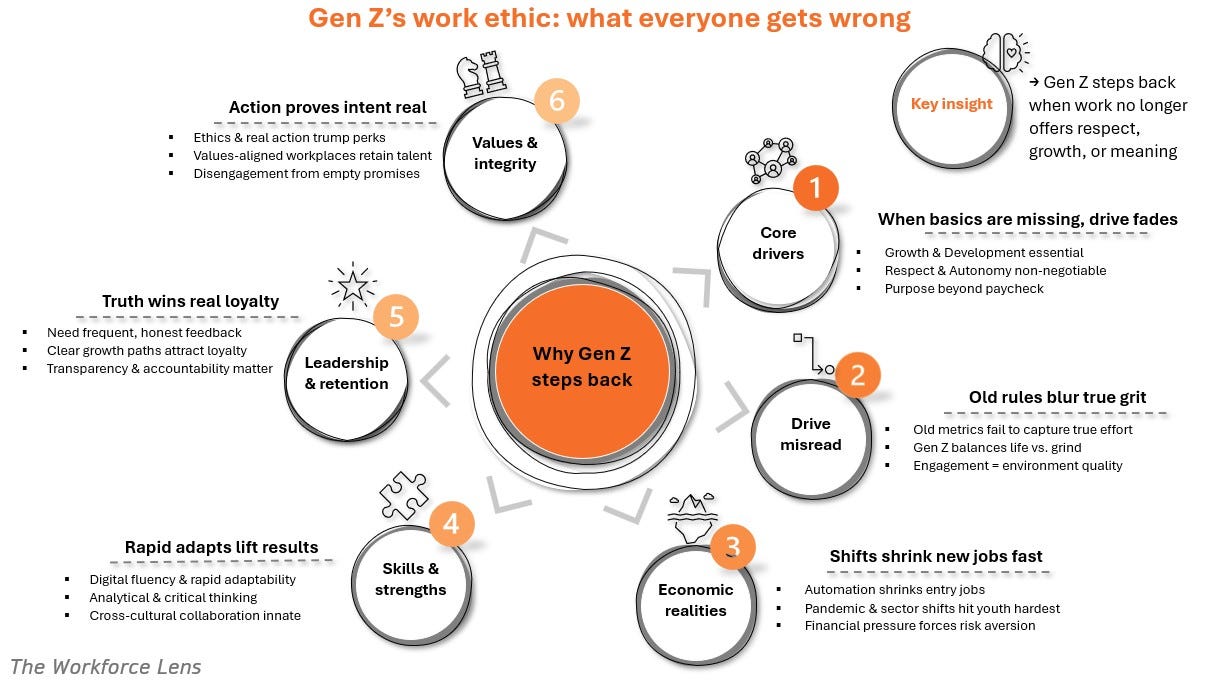
Table of contents:
Why Gen Z refuses to settle for meaningless work
Why effort and engagement look different for Gen Z
Why the economy is stacked against young workers
Why leadership and feedback make or break engagement
Why values and integrity matter more than perks
Key takeaways
Final thoughts: why stepping back is a reflection of the workplace, not the person
Next on The Workforce Lens
Further reading
Why Gen Z refuses to settle for meaningless work
Gen Z wants something older generations also wanted but rarely said out loud: work that feels worth the hours it takes from their lives. They want growth, space to breathe, people who treat them decently, and a role that gives them more than a payslip at the end of the month. Not because they are fragile or demanding, but because they saw what burnout did to the generation before them and decided they would rather not repeat the pattern.
The data backs this up. McKinsey’s research shows that they stay in jobs when there is a path forward, when someone invests in their development, and when the environment feels safe and respectful. Autonomy matters. Flexibility matters. Being spoken to like a human being matters too. They leave when these basics fall apart, not because they lack effort or ambition.
A lot of what gets labelled as entitlement is just people refusing to settle for workplaces that treat them as replaceable. They are not rejecting work. They are rejecting the version of work that drains them and gives nothing back.
“Gen Z is not primarily driven by salary. They are driven by career progression, development, relationships, and workplace flexibility.”
Why effort and engagement look different for Gen Z
Gen Z’s relationship with work is often misunderstood. Their engagement, effort, and skills cannot be measured by old assumptions—they show up differently, and it matters how we look at it.
Why old metrics misread Gen Z’s contribution
People keep saying Gen Z is less engaged, less present, less willing to grind. The numbers do show slightly lower participation, but the conclusion people jump to is the wrong one. It is not laziness. It is not a generation that cannot cope. It is something far more ordinary: a shift in what people is willing to tolerate.
These echoes what we saw in motivation: Gen Z’s effort is present, but it often surfaces in ways older metrics do not capture.
The Harvard Crimson paints a clearer picture. Many younger workers are choosing studies, switching jobs earlier, or cutting their hours because they want a life they can actually live alongside their work. It is not dropping out, but adjusting to a world that feels unstable, expensive, and demanding in ways older generations did not face at the same age. They are pushing back on the idea that full commitment must look like exhaustion.
Lower engagement in some studies mirrors this tension. When work feels rigid, empty, or disconnected from their values, they check out. When it feels meaningful, flexible, and human, they switch on. Their effort has always been there. It just surfaces in environments that treat them as adults with agency, not as a workforce to discipline.
The story here is about people refusing to pour themselves into systems that give nothing back not about declining motivation.
“Many younger workers are choosing studies, switching jobs earlier, or cutting their hours because they want a life they can actually live alongside their work.”
The skills Gen Z brings and how they actually show up
Gen Z grew up inside a world that shifted faster than anyone could process, and it shows in how they work. They pick up new tools in minutes, switch between tasks without drowning, and move across cultures like it is second nature. Not because they are “digital natives,” but because they never had the option to be anything else.
Harvard’s analysis makes it clear: this is a generation that arrives with strong education, sharp analytical skills, and the ability to collaborate in ways older workplace models were never built for. They question assumptions, push for inclusion, and expect workplaces to live up to the values they advertise. Not as a branding exercise, rather as a baseline for respect.
They challenge systems that feel outdated or unfair, not out of rebellion but out of a sense that work should reflect the world they actually live in. Often they speak multiple languages, navigate difference with ease, and are often the first to suggest a better, cleaner way of doing things. This is competence shaped by reality.
Why the economy is stacked against young workers
Gen Z entered a labour market shaped by forces beyond their control. Understanding their unemployment and career choices means looking at the bigger economic picture, not blaming the generation.
Jobs lost to automation and shifting markets
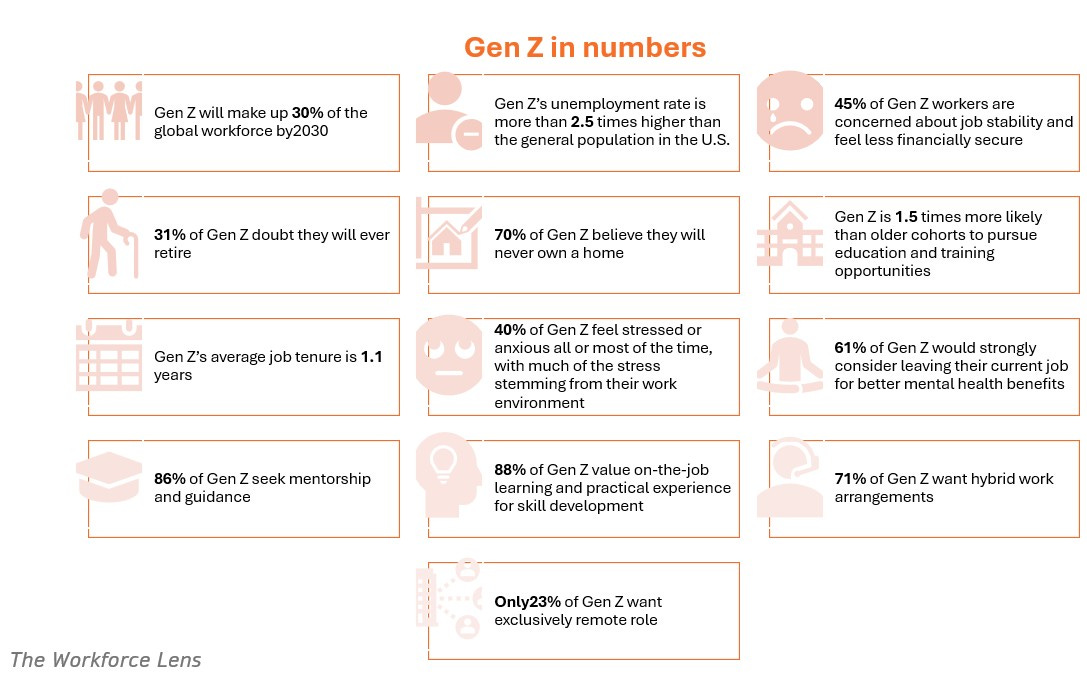
Gen Z is often blamed for unemployment rates they did not create. People talk as if a whole group simply chose not to work, when the truth is far more uncomfortable: the economy shifted faster than the jobs did. The World Economic Forum’s data shows that higher unemployment for Gen Z appears across many advanced economies, especially in service-heavy sectors and regions hit by rapid disruption. This is not about effort. It is not about attitude. It is about a labour market that changed shape while they were still preparing to enter it.
Automation pushed out entry roles. Industries restructured. Post-pandemic shockwaves closed doors that used to be open. Young workers walked into an economy that demanded experience but offered fewer chances to gain it.
When you look at the numbers with any honesty, the narrative falls apart. The unemployment patterns do not point to a generation that refuses to work. They point to structural gaps that no amount of “working harder” can fix.
Blaming young people for macroeconomic forces is not analysis but avoidance.
“Gen Z is often blamed for unemployment rates they did not create. People talk as if a whole group simply chose not to work, when the truth is far more uncomfortable: the economy shifted faster than the jobs did.”
Financial pressure shapes every choice
Beyond these structural shifts in the labour market, these economic realities carry a personal cost: financial pressures shape how Gen Z navigates work, risk, and stability.
Service jobs were the first to get hit. Automation chipped away at routine tasks, companies restructured, and the pandemic ripped out the bottom rungs of the ladder entirely. So when people say Gen Z is unemployed because they “do not want to work,” they are ignoring the reality: the roles that used to absorb young talent never fully came back.
And then there is the financial side—the part everyone loves to judge without understanding. This generation is not risk-averse by nature. They are risk-averse because the stakes are higher. Rent eats half a salary. Student debt hangs over them. A single month of unemployment can push someone into a hole they cannot climb out of. Economic pressure shapes their choices more than preference ever could.
They are not choosing “safe” jobs out of fear but because instability has defined their entire entry into adulthood.
Why leadership and feedback make or break engagement
Gen Z does not just want a boss—they want someone who notices them, guides them, and actually cares about how they grow. Feedback is not a once-a-year checkbox. Mentorship is not optional. They leave jobs when leaders ignore this because they need work to feel like more than a series of tasks.
They respond to inspiration, not to micromanagement. They stick around when someone shows them a path forward, invests in their skills, and treats them like people, not numbers. Without that, loyalty dries up fast, and they move on because they are searching for meaning, growth, and relationships that make the work worth it.
They notice when leaders give vague directions, fail to follow through, or treat mentorship as a box to tick. Small gestures such as checking in, recognising effort, giving clear guidance, make a tangible difference. They can sense when feedback is genuine versus perfunctory, and they invest their energy accordingly.
Gen Z also values leaders who acknowledge mistakes openly and share lessons. They do not expect perfection, instead they expect accountability. A culture where mistakes are hidden or ignored is one where disengagement grows, while transparent, supportive leadership encourages initiative, problem-solving, and trust.
“Gen Z stays in jobs when there is a path forward, when someone invests in their development, and when the environment feels safe and respectful.”
Why values and integrity matter more than perks
In offices and remote teams alike, young employees are watching closely. Every action, every policy, every promise is noticed. They stay where the work reflects values, and they disengage when it does not.
For them, ethics, inclusion, and social responsibility are non-negotiable. Workplaces that ignore this lose attention, effort, and loyalty. They stay where actions match words and leave where promises feel empty. Respect and authenticity matter more than perks or titles.
They are drawn to organisations that make tangible contributions, whether through sustainability efforts, community engagement, or initiatives that tackle inequity. It is not about appearances—they pay attention to follow-through, to whether policies and practices reflect stated principles.
This generation expects to participate in work that aligns with their own sense of responsibility. If a company’s actions contradict its claims, Gen Z notices and adjusts their engagement accordingly. They care about the world outside their office walls as much as inside, and they look for opportunities to make impact in both spheres.
💡 Related read:
How AI is reshaping entry-level careers: risks, skills, and strategies
Discover how artificial intelligence is transforming entry-level roles, the risks it poses for new talent, and the skills needed to thrive in a rapidly evolving job market. Learn how organisations can adapt to support Gen Z’s career growth and bridge the gap between automation and opportunity.
Key takeaways:
Gen Z values meaningful work and growth over pay → organisations must offer more than a salary to attract and retain them
Engagement depends on autonomy, flexibility, and being treated as an adult → rigid work reduces effort even from capable employees
Lower participation reflects misaligned work or values, not laziness → leaders must assess context, not just metrics
Economic shifts (automation, sector changes, post-pandemic effects) drive youth unemployment → policies and planning must address structural barriers
Gen Z’s skills—digital fluency, analytical thinking, cross-cultural competence—are underused if not leveraged → organisations risk wasting talent
Leadership and values alignment influence retention → unclear management or inconsistent practices erode trust and engagement
Final thoughts: why stepping back is a reflection of the workplace, not the person
Gen Z has witnessed the consequences of burnout and low-value work in the generation before them. They enter the workplace expecting more than a salary. They want to invest time and effort in roles that allow them to learn, grow, and feel respected. When work fails to offer that, they step back—not out of laziness, but because the environment shapes what people are willing to give.
Leadership plays a crucial role in this. Engagement arises from clear guidance, honest feedback, and visible accountability. People respond to leaders who notice their contribution and offer genuine support, not to those who simply give orders or tick boxes. When leadership is inconsistent or indifferent, motivation diminishes and talent disperses. How much someone gives is a reflection of the environment, not the person.
Equally, alignment between values and actions matters deeply. Gen Z notices when organisations’ words fail to match deeds. They expect their work to contribute to something meaningful beyond themselves, and they adjust their engagement accordingly. Empty promises, superficial initiatives, or inconsistent policies erode trust and energy. For commitment to be sustained, work must reflect both competence and integrity; the impact of effort is felt not only inside the organisation but also in the broader world it claims to influence.
Can we blame Gen Z for stepping back when work lacks meaning, respect, and integrity?
Next on The Workforce Lens:
Gen Z enters work under economic pressure, demographic imbalance, and expectations formed in a world far more unstable than the one many leaders stepped into years ago. Their choices highlight where work stops making sense, where systems feel outdated, and where employers fail to provide direction that supports effort over time. These shifts raise questions about what kind of labour market the world aims to build and what responsibilities fall on employers, not only on individuals.
The next piece turns to that exact tension: how workplaces create conditions that either support early careers or undermine them before they start. It shows where old assumptions distort decisions, where leadership habits fall out of step with labour realities, and why these patterns matter for competitiveness in the decade ahead.
Further reading:
For understanding the unique needs of a multigenerational workforce, “Generational diversity in the workplace: key HR strategies to improve engagement and retention“ reveals how tailored HR approaches—such as flexible work models, targeted learning, and inclusive leadership—can boost engagement, retention, and performance across all age groups.
For navigating the changing landscape of entry-level careers, “How AI is reshaping entry-level careers: risks, skills, and strategies“ unpacks how artificial intelligence is transforming job opportunities, the risks for new talent, and the skills organisations must foster to support Gen Z’s career growth and adaptability.
For understanding the impact of AI on the future of work, “The AI Index Unveiled: How Artificial Intelligence is Reshaping Jobs and Skills“ examines how automation and new technologies are transforming the skills required for success and the implications for Gen Z’s entry into the workforce.
Readers favourites:
Remote Work Laws You Cannot Ignore: A Global Guide to Compliance
Remote Work in Transition: Benefits, Challenges, and Employee Preferences
How AI is reshaping entry-level careers: risks, skills, and strategies