
Workforce transformation made real: Singapore’s lifelong learning model and HR insights
Empowering HR leaders with actionable lessons from Singapore’s evolving skills ecosystem to build adaptable, future-ready teams

Singapore’s approach to lifelong learning offers a concrete example of how embedding continuous skill development across society can build workforce resilience. It shows how coordinated effort between government, industry, and education can create a system where adaptability is not just encouraged but structurally supported. For HR, this model presents valuable insights into designing learning cultures that are inclusive, proactive, and closely aligned with economic shifts—offering a real-world blueprint for navigating change in the workplace.
What you will learn from this article:
Understand the strategic role of lifelong learning in national economic resilience and workforce agility
Examine Singapore’s systemic approach to integrating government, industry, and academia in skills development
Analyse the design and impact of the “SkillsFuture” initiative on upskilling and career transitions
Explore the contribution of universities as innovation hubs aligned with evolving labour market demands
Evaluate evidence of measurable outcomes including employment stability, wage premiums, and learner satisfaction
Consider challenges and nuances related to equity, inclusivity, and transferability of lifelong learning models
Why it is relevant to HR?
The ability to learn and adapt throughout one’s career has become non-negotiable in today’s fast-changing world. For HR, this means moving beyond traditional training to embed continuous skill development into the very fabric of workforce management. Recognising and addressing the real barriers people face—whether time, resources, or confidence—is crucial to making lifelong learning accessible and effective. HR’s role is to shape an environment where adaptability is not just encouraged but built into everyday practice, ensuring both individuals and organisations remain resilient in the face of constant disruption.
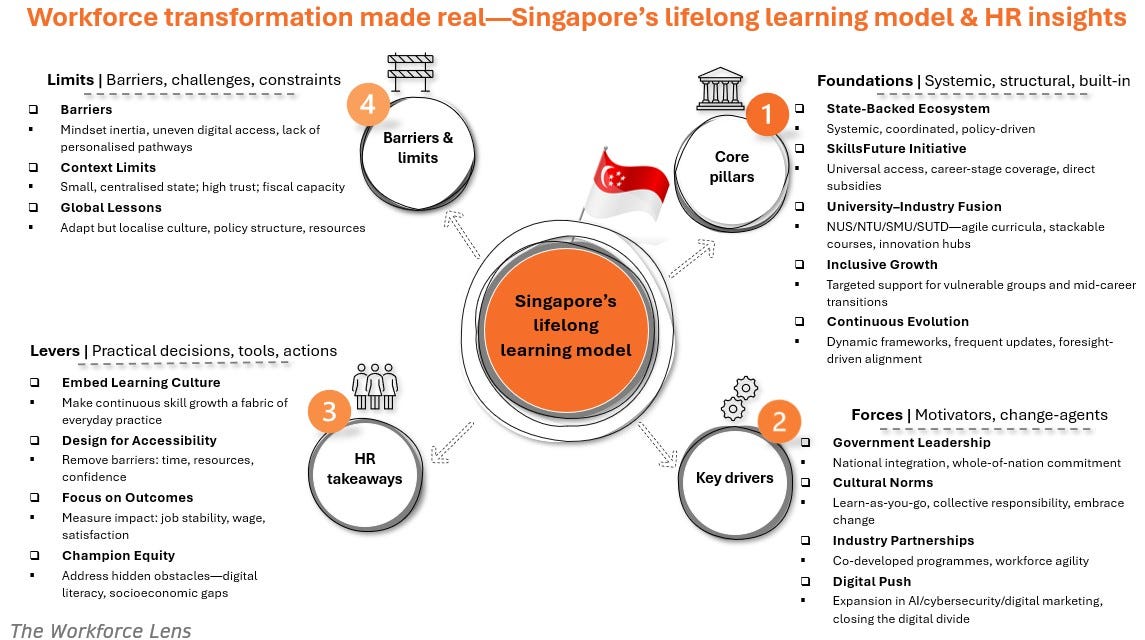
Table of contents:
The national lifelong learning ecosystem: how Singapore builds workforce resilience
Social and cultural drivers of lifelong learning in Singapore
Flagship initiative: “SkillsFuture” and its impact on careers and industry
Universities as innovation engines driving skills and industry alignment
Measurable impact and inclusion in Singapore’s lifelong learning system
Equity and inclusivity nuances in lifelong learning participation
Lessons for other nations from Singapore’s lifelong learning blueprint
Contextual limitations and transferability challenges of the Singapore model
Key takeaways
Final thoughts: Singapore’s lifelong learning ecosystem as a roadmap for workforce resilience and national adaptability
What is next
Further reading
The national lifelong learning ecosystem: how Singapore builds workforce resilience
Unlike most countries where lifelong learning remains an aspiration or a policy slogan, Singapore’s approach is systemic, state-backed, and embedded at every level of society. The country has treated lifelong learning not as a supplemental activity but as an essential pillar of its economic and social strategy, ensuring that education and skills development extend far beyond the formal schooling years.
💡 Related read:
Future‑proof your workforce: how strategic upskilling and reskilling drive business success
Discover how targeted upskilling and reskilling boost agility, cut hiring costs, and keep top talent. Learn the difference between strengthening existing skills and preparing people for new roles, tackle common barriers to learning, and see how to align development with business goals for measurable impact. Packed with practical steps and cultural shifts to make continuous learning part of everyday work—and your competitive advantage.
Embedding lifelong learning in national strategy for economic resilience
National Policy Integration sits at the heart of this model. The Singapore government collaborates seamlessly with industry, trade unions, and top-tier universities, creating a tightly interconnected ecosystem in which training and education are continuously aligned with the realities of an ageing workforce and the demands of an evolving global economy.
Coordinated partnerships driving workforce agility and skill alignment
This is not a static arrangement but a dynamic, feedback-driven system where industry skill needs are rapidly identified and translated into updated curricula, sectoral training frameworks, and professional certification pathways. This whole-of-government and multi-stakeholder approach ensures that policies are not designed in isolation. Ministries, employers, and educational institutions work in lockstep to anticipate change, proactively close skills gaps, and maintain Singapore’s competitive position in the global market. Internationally, this model is recognised as a benchmark for scalable and adaptable workforce development (Adult lifetime skills: a literature review, 2023), offering a living example of how public–private collaboration can deliver both economic resilience and social inclusion.
“Strong partnerships with education institutions, industry partners and employers are keys to success. Everyone needs to play a part in building up a responsive and effective skills ecosystem to establish a highly skilled workforce in the spirit of lifelong learning.”
Source – SpringerLink
Social and cultural drivers of lifelong learning in Singapore
Lifelong learning extends beyond policy frameworks and institutional programmes; it deeply intersects with the social and cultural fabric of a nation. Singapore’s success reflects not only structural design but also a profound cultural embrace of continuous learning as a personal and communal value.
Shaping a culture of continuous learning for career longevity
Cultivating this culture has required deliberate efforts to shift mindsets across generations and socio-economic groups. The state’s promotion of lifelong learning as a social norm—reinforced through public campaigns, employer incentives, and visible leadership endorsement—helps embed it in everyday life. This cultural positioning reduces stigma around mid-career reskilling and normalises upskilling as a necessary, respected endeavour rather than a remedial activity.
Balancing collective identity and individual agency in skills development
Furthermore, the narrative of lifelong learning in Singapore is closely tied to national identity and economic survival. Citizens are encouraged to view skills development as part of their contribution to the country’s ongoing growth and resilience, reinforcing a collective responsibility alongside individual agency.
However, sustaining this culture demands ongoing attention. Diverse populations may experience varying degrees of motivation, access, and support. Lifelong learning must therefore be framed not only as an economic imperative but also as an enriching process that connects learners to community, purpose, and opportunity beyond employment metrics.
Flagship initiative: “SkillsFuture” and its impact on careers and industry
The “SkillsFuture” initiative stands as a central pillar of Singapore’s lifelong learning strategy, reflecting both its scale and ambition. Its design and outcomes offer valuable insights into how a coordinated, well-funded system can promote continuous skills development across all career stages.
Programme design and features of Singapore’s “SkillsFuture” model
The “SkillsFuture” Movement, launched in 2015, represents one of the world’s most comprehensive lifelong learning and upskilling systems. It is more than a funding programme; it is an infrastructure for continuous capability-building, designed to ensure every citizen—regardless of career stage—has access to relevant, high-quality learning opportunities. “SkillsFuture” provides direct subsidies, course credits for all adults—including a dedicated allocation for mid-career workers—robust sectoral skills frameworks, and visible leadership involvement to reinforce its importance. Over time, it has catalysed a cultural shift embedding continuous learning as a social norm.
“SkillsFuture comprises a range of initiatives that aim to strengthen the link between the education system and the labour market, to provide individuals with the information and support they need to make well‑informed choices about their skills development.”
Source – gov.scot, Adult lifetime skills: a literature review
Outcomes and impact of lifelong learning on jobs, wages, and skills
The scale of participation reflects its reach and impact. In 2023, more than 520,000 individuals and 23,000 enterprises took part in “SkillsFuture”-supported training, with a marked rise in mid-career engagement. By 2024, 260,000 Singaporeans used “SkillsFuture” Credits—a 35% increase from 192,000 the previous year—including about 28,000 mid-career workers pursuing substantive reskilling. Participation in IT-related courses such as artificial intelligence, cybersecurity, and digital marketing nearly tripled from 34,000 to 96,000, mirroring Singapore’s accelerated digital transformation.
“With the wide range of SkillsFuture initiatives, it is important to track training outcomes and the effectiveness of training. At the national level, the training participation rate of Singaporeans in 2018 was at 48%. According to the survey, 8 in 10 Singaporeans who attended SkillsFuture-funded courses last year found that their training helped them in their work.”
SpringerLink – Developing a Robust System for Upskilling and Reskilling the Workforce
Expanding programmes, delivering results: lessons for HR and policymakers
Programme breadth has expanded in tandem: the number of career transition courses rose from 179 in 2023 to 239 in 2024, supporting over 14,000 individuals, with more than half securing employment within six months of completion. Feedback from learners demonstrates strong satisfaction and tangible workplace benefits. In 2024, nearly 7 in 10 participants reported improved work performance (up from 65% in 2023), over 84% found training directly applicable to their work, and 64% credited “SkillsFuture” learning with advancing their careers (Fung, 2020; Zher & Lin, 2023; “SkillsFuture” Year-In-Review 2024; BT Report 2024; SSG Newsroom 2024).
Universities as innovation engines driving skills and industry alignment
Singapore’s leading universities—National University of Singapore (NUS), Nanyang Technological University (NTU), Singapore Management University (SMU), and Singapore University of Technology and Design (SUTD)—are not simply higher education providers. They act as active engines of national adaptability, aligning closely with industry to ensure that the workforce is continuously equipped with skills relevant to an evolving economy.
Tailored learning platforms meeting evolving industry needs
NUS has positioned its School of Continuing and Lifelong Education (SCALE) as a central platform for adult learning. It delivers agile, modular, and stackable courses that allow participants to build Industry 4.0 capabilities at their own pace, ensuring they can respond effectively to rapidly shifting labour market demands.
NTU, through its Academy for Professional and Continuing Education (PaCE), integrates workforce-relevant instructional design with international collaborations involving research centres specialising in lifelong learning and cognitive adaptability. Its FlexiMasters programme allows professionals to accumulate credentials incrementally, enabling them to adapt qualifications to meet emerging industry needs without pausing their careers.
Forecasting and anticipating skills demand to future‑proof talent
SMU Academy delivers over 1,500 highly specialised, workplace-relevant programmes, leveraging strong data-driven partnerships with industry leaders. It also develops skills forecasting capabilities critical for talent cultivation in sectors such as finance, human capital, and technology (Fung, 2020). This foresight-driven approach ensures that training anticipates skill demand rather than reacting to shortages after they occur.
Together, these universities form a strategic bridge between academic research, industry needs, and national policy, reinforcing Singapore’s position as a nation that treats learning as a continuous, collaborative process rather than a discrete phase of life.
Measurable impact and inclusion in Singapore’s lifelong learning system
The combined effect of “SkillsFuture” and university-led training programmes is visible not only in individual learner outcomes but also in national labour market resilience. Research shows these programmes enhance job security, increase incomes, and support career advancement. Singapore’s unemployment rates have remained stable even during economic shocks, a sign of the workforce adaptability fostered by these initiatives. Survey findings reinforce this impact: 98% of learners reported improved job performance, 93% credited training as pivotal for career growth, and 95% confirmed the transferability of their learning to their work. Measurable wage premiums and strong job placement rates further confirm the tangible economic benefits of this lifelong learning ecosystem (Renold et al., 2018; SkillsFuture Year-In-Review 2024; SSG Newsroom 2024).
Industry co‑development as a driver of relevant, effective training
Industry Co-Development is a defining feature of the model. Programmes are continually co-designed with leading employers, government agencies, and universities, ensuring they remain aligned with current and projected skill needs. This demand-driven approach means training is relevant and immediately applicable, shortening the time between skill acquisition and productive use.
Inclusive growth as a deliberate strategy for resilient labour markets
Inclusive Growth is embedded into policy and programme design. Targeted measures ensure that vulnerable populations and mid-career individuals affected by technological disruptions receive additional support. These include tailored course credits and personal learning accounts, encouraging sustained engagement in skills development (Zher & Lin, 2023). This inclusion is not only a social good but a strategic choice to maximise national human capital in an economy where technological change can otherwise displace workers.
Equity and inclusivity nuances in lifelong learning participation
Singapore’s lifelong learning ecosystem explicitly targets inclusivity—particularly supporting mid-career workers and vulnerable populations—but the challenges of equity run deeper and require nuanced consideration.
Barriers beyond cost: tackling hidden obstacles to lifelong learning
Access to lifelong learning can be uneven due to educational background, language proficiency, digital literacy, and socioeconomic status. Despite generous subsidies and course credits, barriers remain for individuals who face competing responsibilities, limited time, or lower confidence in returning to formal learning environments.
From participation to outcomes: ensuring equity in career results
Inclusivity efforts must address outcome disparities as well as participation rates. Do learners from disadvantaged backgrounds achieve comparable career advancement and wage growth as their peers? Are support mechanisms tailored to specific needs, such as flexible scheduling, childcare, or foundational skills training?
Closing the digital divide to make digital skills accessible to all
The system’s reliance on digital platforms for course delivery—exemplified by the surge in IT-related training—raises concerns about the digital divide. Equitable access requires proactive measures for those with limited technology skills or connectivity, lest the system inadvertently widen gaps.
Measuring what matters: tracking equity and impact in skills development
Meaningful inclusion requires ongoing data collection and transparent reporting on equity metrics to monitor progress and identify areas for improvement. A commitment to equity must move beyond policy statements to actionable strategies dismantling structural barriers and empowering all learners to thrive.
Lessons for other nations from Singapore’s lifelong learning blueprint
Singapore’s lifelong learning ecosystem offers a replicable blueprint for countries seeking to strengthen workforce adaptability and social resilience.
Whole-of-Nation Commitment is at the core. Ministries, employers, unions, and educational institutions treat lifelong learning as a shared national responsibility rather than a discrete policy area. This is reinforced by broad public participation and government-led campaigns emphasising continuous skills mastery as both an economic necessity and a civic value.
Constant Evolution is ensured through “SkillsFuture’s” Sector Skills Frameworks and frequent programme realignments. This recalibration allows the system to evolve with technological progress and absorb shocks of market disruption, ensuring no skills framework becomes obsolete (Fung, 2020).
Global Reference Point status has been earned through data-driven and evidence-backed policy design. International assessments—such as the Scottish Government’s literature review—consistently cite Singapore as a leading example of a scalable, adaptable, and high-impact approach to adult lifelong learning (Adult lifetime skills: a literature review, 2023).
Contextual limitations and transferability challenges of the Singapore model
While Singapore’s lifelong learning ecosystem offers an inspiring blueprint, its unique contextual factors enable its success—factors not easily replicable elsewhere.
Distinct advantages of Singapore’s model for workforce transformation
Singapore is a small city-state with a highly centralised government and strong policy coordination capabilities. Its compact size facilitates seamless collaboration across ministries, industries, and educational institutions, enabling rapid decision-making and policy implementation. Additionally, Singapore benefits from a high level of public trust in government, social cohesion, and a culture traditionally valuing education and discipline. These conditions create an environment where lifelong learning policies can be embedded deeply and scaled efficiently.
Challenges for other nations in replicating Singapore’s approach
In contrast, larger countries with federal structures, fragmented governance, or diverse populations may face significant challenges in achieving the same whole-of-nation alignment. Policy fragmentation, varying regional priorities, and resource disparities can hinder cohesive strategies. Political will and administrative capacity vary widely, impacting sustained funding and oversight for lifelong learning systems.
Beyond governance, socioeconomic and cultural differences also affect learner engagement. Singapore’s emphasis on continuous skills mastery is supported by a strong societal narrative around meritocracy and individual responsibility, which may not translate directly to countries with different cultural attitudes towards education, work, and state intervention.
Finally, the financial sustainability of Singapore’s approach—providing extensive subsidies, course credits, and tailored support—relies on its relatively robust fiscal position. Nations with constrained budgets may find such funding models difficult to replicate without adaptations or prioritisation.
For these reasons, while Singapore’s system offers valuable lessons, transferability requires careful consideration and contextual adaptation. Policymakers must account for local governance structures, cultural values, economic capacities, and social dynamics to design lifelong learning ecosystems that are effective and sustainable in their own contexts.
“The Singapore system benefits from strong central government coordination, substantial investment, and societal consensus about the value of lifelong learning. These factors may pose challenges for countries with more decentralised systems or differing cultural attitudes to education.”
Source – gov.scot, Adult lifetime skills: a literature review
Key takeaways:
Lifelong learning is a strategic imperative for national economic resilience and workforce adaptability in an era of rapid technological change
Singapore’s success stems from a fully integrated ecosystem where government, industry, and universities collaborate seamlessly to anticipate and meet evolving skill demands
The “SkillsFuture” initiative exemplifies how sustained public investment, and cultural endorsement can drive widespread participation and meaningful career advancement
Universities act as dynamic innovation engines, delivering flexible, industry-aligned programmes that prepare learners for future-ready skills
Measurable outcomes—stable employment, wage growth, and high learner satisfaction—underscore the tangible benefits of a well-orchestrated lifelong learning system
Achieving equity and inclusivity requires deliberate strategies addressing access barriers and outcome disparities, ensuring no learner is left behind
While Singapore offers a compelling model, contextual adaptation is critical for other nations seeking to replicate its success
Final thoughts: Singapore’s lifelong learning ecosystem as a roadmap for workforce resilience and national adaptability
Singapore exemplifies how lifelong learning is not merely a policy aspiration but a strategic imperative for national resilience amid rapid technological change and dynamic labour markets. Its comprehensive, state-backed system protects workers from skill obsolescence, drives economic growth, and sustains national competitiveness.
This success stems from deep integration and whole-of-nation commitment, where government agencies, universities, employers, and individuals align efforts and share responsibility. This coordination underscores a critical lesson: isolated training efforts or fragmented policies are insufficient to achieve workforce agility in today’s fast-evolving landscape.
By focusing on inclusion—especially empowering mid-career adults and vulnerable workers—Singapore fosters social cohesion and equitable opportunities, addressing an urgent global challenge in workforce adaptation.
Furthermore, Singapore’s system delivers measurable outcomes—high learner satisfaction, employment stability, meaningful wage premiums, and strong employer engagement—demonstrating this approach is a genuine, replicable blueprint for workforce development.
For policymakers and industry leaders worldwide, Singapore offers a proven model emphasising lifelong access, demand-driven curricula, and proactive evolution keyed to economic signals and emerging technologies.
Finally, Singapore’s forward-looking preparation in areas such as artificial intelligence, sustainability, and digital fluency highlights that lifelong learning systems must remain dynamic, flexible, and foresight-driven to stay relevant.
Singapore’s lifelong learning ecosystem shows that national-scale workforce adaptability and economic resilience are achievable when lifelong learning is deeply embedded in policy, practice, and culture. It offers a roadmap not just for survival but for thriving in the new world of work.
“By embracing a skills-first approach, recruiters and hiring managers must cultivate open-mindedness, recognising that exceptional talent often transcends traditional qualifications. Concurrently, employers must commit to accelerating the upskilling and reskilling of their workforce, ensuring relevance and adaptability in an ever-evolving landscape.”
SkillsFuture Singapore Report (PDF)
What is next:
People want more control, more meaning, and more recognition—but work, by its very nature, comes with limits. Schedules cannot always bend, operations cannot pause, and resources are finite. That friction—the constant push of expectations against reality—is where frustration grows, turnover begins, and engagement quietly slips away. It is also where insight waits: understanding which tensions matter most, how they ripple through teams, and which choices shape experience without undermining performance.
The next exploration will look closely at these collisions in real workplaces: the moments when ambition meets operational reality, when goodwill strains against unavoidable constraints, and when employees either adapt, resist, or quietly disengage. It will uncover how small, deliberate decisions can turn tension into clarity rather than conflict—and what patterns distinguish organisations that survive from those that slowly lose their people.
When every expectation cannot be met, what separates workplaces that manage the pressure from those that buckle under it?
Further reading:
If you want to learn how to bridge the expectations of four very different generations at work, “Generational diversity in the workplace: key HR strategies to improve engagement and retention” explores how HR leaders can turn age diversity into a competitive advantage—by adapting leadership, communication, and learning to meet each generation’s values and work styles.
If you want to see how emerging technologies are transforming work at the task level, “The AI Index Unveiled: How Artificial Intelligence is Reshaping Jobs and Skills” breaks down where AI is replacing tasks, where it’s augmenting human work, and which skills will define employability in an AI-driven economy.
If you want to design hybrid work that actually works, “The art of hybrid: designing a work model that fuels success” reveals how to combine flexibility and collaboration through intentional policy, leadership training, and office design—creating an environment where both people and performance thrive.
Readers favourites:
Remote Work Laws You Cannot Ignore: A Global Guide to Compliance
Remote Work in Transition: Benefits, Challenges, and Employee Preferences
How AI is reshaping entry-level careers: risks, skills, and strategies

References
Annex B: Case Studies - Adult lifetime skills: a literature review - gov.scot
More Employers and Mid-Career Workers taking up SSG-Supported training | SkillsFuture Singapore
Does it pay for firms? Costs and benefits of the SkillsFuture Earn and Learn Programme in Singapore
The Impact of Singapore’s SkillsFuture Credit on Training Participation