What people want from work: how values and motivators have shifted
Tracing the shifting priorities that have changed how we view work over time Brief:

Work has changed, but not everyone has noticed. The rules that once defined a “good job”—security, tenure, predictable progression—no longer tell the whole story. People now measure their work by how it fits their lives, values, and ambitions. They want to grow, to belong, to move when the world around them shifts. The numbers, trends, and historical shifts reveal a workforce that judges’ jobs by more than pay cheques or titles. Understanding why people stay, leave, or invest themselves in work offers a glimpse into the forces quietly shaping organisations and careers today.
What you will learn from this article:
How workers’ priorities have shifted over decades, from job security and tenure to flexibility, autonomy, and meaning
Why these changes occurred, including the impact of generational values, digital transformation, and social expectations
The role of personalisation, community, and future-ready skilling in shaping modern work preferences
How voluntary job mobility drives productivity, wage growth, and career development today
The rising importance of non-financial motivators—belonging, alignment with values, work-life balance—and their measurable impact on retention
Why organisations must rethink how they attract, develop, and retain talent in a world where meaning, identity, and adaptability matter as much as pay
Why it is relevant to HR?
HR cannot ignore how work is changing. People no longer measure a job by pay cheques or titles alone—they notice whether their work fits their values, whether they feel seen and included, and whether they have space to learn and adapt. Seeing these changes clearly matters because whether people stay, leave, or grow depends on them. How work feels, how people move and learn, and how they connect every day makes the difference. If HR fails to grasp how priorities, mobility, and skills are evolving, organisations risk losing not only talent but also the energy, creativity, and trust that people bring when work actually works for them.
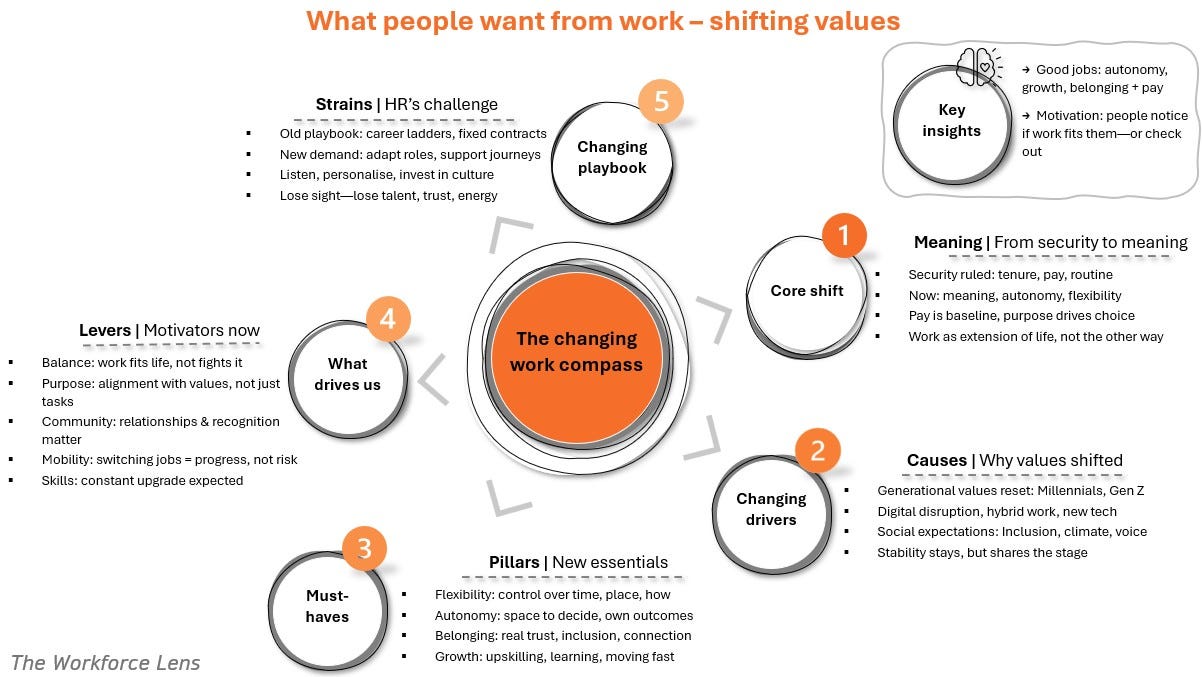
Table of contents:
Chapter 1: how job security lost its grip and what replaced it
Chapter 2: why worker needs shifted—key drivers explained
Chapter 3: the real motivators driving retention and growth
Key takeaways
Final thoughts: work redefined—lessons from decades of change
What is next
Further reading
Chapter 1: how job security lost its grip and what replaced it
Major global surveys and longitudinal datasets (OECD, World Economic Forum, ILO) show how sharply workers’ core preferences have shifted in recent decades. In the late 20th century, security was the dominant value in Europe, North America, and OECD economies. A “good job” meant stable pay, pension rights, fixed hours, and predictable seniority-based progression. OECD data on job tenure underlines this: in the 1980s, it was common in countries like Germany, Japan, or France for employees to stay with one employer for 20 or more years, with careers mapped out almost automatically.
This began to change in the 2000s. Demographic shifts, technological disruption, and globalisation unsettled industries that once symbolised stability. At the same time, younger generations came into the labour market with different values. World Economic Forum surveys show that by the mid-2010s, workers under 35 placed flexibility, development, and meaningful work ahead of tenure or predictable promotion paths.
Security never disappeared—economic shocks like the 2008 financial crisis or COVID-19 showed how vital it still is—but it lost its place as the single defining measure of a “good job.” Today, flexibility, autonomy, development, and meaning sit alongside security, reshaping what people expect from their work.
💡 Related read:
The AI Index Unveiled: How Artificial Intelligence is Reshaping Jobs and Skills
The AI Index reveals how rapid advancements in artificial intelligence are transforming job roles, skill requirements, and the future landscape of work across industries worldwide.
Chapter 2: why worker needs shifted—key drivers explained
The shift in what people want from work did not happen in a vacuum. Large-scale surveys, including the World Economic Forum’s Workmonitor 2025, show that employees now build their expectations around three pillars that would have sounded almost secondary in the job markets of the 1980s and 1990s. Security still matters, but it is no longer enough on its own. What has risen instead are needs that speak to identity, connection, and the ability to adapt to a world where the ground keeps moving beneath our feet.
Workers today want their jobs to reflect who they are, not just what they do. They want more than colleagues; they want belonging. And they no longer see skills as fixed assets gained in school or early training—they expect continuous opportunities to reskill and adapt. These three themes show up consistently in longitudinal data across regions and generations:
Personalisation: Work that aligns with individual values, circumstances, and ambitions
Community: A sense of genuine belonging and positive workplace relationships
Future-ready skilling: Opportunities for ongoing learning and adaption, particularly in fast-changing sectors and digital technology roles
“At the heart of this transformation lies a new baseline for how people see work, which has three pillars: Personalization—work that aligns with individual values, ambitions and life circumstances; Community—a sense of belonging at work; Future-ready skilling—opportunities to build and sustain relevant skillsets for tomorrow’s challenges.”
Investing in workplace culture to help advance careers | World Economic Forum
The deeper reasons behind these changing priorities are structural as much as cultural.
Digital transformation and job automation have accelerated demand for reskilling, continuous learning, and mobility between roles. Jobs themselves shift too quickly to make static skills or long tenures a safe bet
Social movements and generational demands—driven particularly by Millennials and Gen Z—have redefined what a “good job” looks like. Flexibility, remote or hybrid work, climate values, inclusion, and diversity have moved from optional perks to baseline expectations
Weakened lifetime job guarantees mean workers are more likely to change employers voluntarily, often in search of better pay, stronger alignment with their values, or a healthier culture, rather than clinging to stability for its own sake. OECD’s Employment Outlook 2025: Reviving growth in a time of workforce ageing stresses that this mobility is not a marginal trend but an essential force reshaping labour markets
These drivers have not only rewritten how people think about their own careers but also how organisations compete for talent. In many ways, they mark the end of an era where work was defined primarily by contracts and job descriptions, and the beginning of one where meaning, identity, and adaptability carry as much weight as pay or tenure.
Chapter 3: the real motivators driving retention and growth
The way people talk about motivation at work has shifted from a narrow focus on pay to a much broader set of factors that touch everyday life and long-term growth. Money still matters—it always will—but it is no longer the single driver keeping people in jobs or attracting them to new ones. What stands out in the data is how strongly non-financial motivators now shape choices, loyalty, and turnover. Surveys by the World Economic Forum show that work is no longer seen just as a source of income, but as a space that must align with values, provide growth, and allow room for life outside it.
Recent WEF reporting finds:
Work-life balance is now a top motivator for 83% of workers globally. Pay remains essential, but the relative weight of non-financial motivators is rising
44% of workers say they would leave if they disagreed with leadership’s values—a sharp increase compared to earlier years
40% would quit if upskilling and career development are not supported
More than half place greater trust in their employer when flexible, personalised benefits are available
55% would quit if they did not feel a sense of belonging—whereas previous generations were far less likely to cite this as a reason for turnover
The OECD’s Employment Outlook 2025 offers a complementary perspective, focusing not just on attitudes but on actual labour market behaviour. The data shows that mobility—once seen as risky or even disruptive—is now central to how economies grow:
Job-to-job mobility, where people voluntarily move to higher-wage and higher-productivity firms, has become a key driver of both productivity and wage growth. In the past, these gains were mostly achieved through “intra-firm” advancement rather than switching employers
Younger workers show greater dynamism, frequently changing roles to increase pay or broaden experience. In contrast, lower mobility among older workers slows overall wage and productivity growth
Policies that support voluntary mobility, learning, and adaptability are now crucial for sustaining growth and limiting inequality across generations
“Mid-career and older workers tend to be less mobile than younger workers and less likely to transition to higher-quality firms through the ‘job ladder’. As a result, workforce ageing may contribute to slow down aggregate wage and productivity growth.”
Together, these findings paint a clear picture: motivation is less about locking people into contracts and more about creating conditions that keep them choosing to stay. The numbers show a workforce that expects alignment, growth, and balance—not as luxuries, but as baselines.
Key takeaways:
The idea of a “good job” has shifted. Security alone no longer defines it; people now measure work by whether it gives them autonomy, purpose, and room to grow alongside stability
Younger generations are testing the old assumptions: lifetime employment, rigid hierarchies, and predictable progression feel increasingly limiting in a fast-moving world
Connection at work—real belonging, trust, and alignment with values—is not a luxury; it is often the deciding factor in whether people choose to stay or leave
Skills are not fixed. The capacity to learn, adapt, and move between roles is now as important as experience or qualifications, and it drives both individual and collective progress
Mobility is not instability. It reflects workers’ responses to industries, opportunities, and cultural fit, and it can accelerate productivity and wage growth when supported intentionally
The data shows a deeper truth: when work respects people as whole human beings—with life, values, and aspirations in mind—they invest more than hours; they invest themselves. Neglecting this creates disengagement that no bonus or title can fix
Final thoughts: work redefined—lessons from decades of change
Work is not just about stability anymore. People still want it, but they also want space to think, to grow, to feel like what they do matters. They notice if they belong or if their skills are used. They notice if they can change, learn, or move without everything collapsing around them. Small things add up, and they decide if they stay, leave, or give their attention somewhere else.
It was not always like this. Decades ago, a “good job” often meant one employer for life, a clear path up the ladder, and predictable pay. Security ruled. Slowly, over time, those rules started to bend. Technology, globalisation, generational change, and social shifts began to rewrite what people expected from work. Flexibility, learning, and connection crept in alongside stability—and now they sit firmly at the centre of how people judge their work.
The data shows it again and again: when work fits life, values, and learning, people pour themselves into it. When it does not, they check out quietly, bit by bit, often before anyone realises. HR matters because it touches that every day. Understanding the shift is not about policies or perks—it is about noticing how work feels, what it does to people.
If work is now a conversation between people and the roles they hold, the question is: how will workplaces change to keep people, not just jobs, alive?
What is next:
In the next article, we explore how the gig mindset is quietly rewriting the rules of work—reshaping not just contracts and careers, but the very meaning of stability and success. Once a niche trend for freelancers and platform workers, it has now spread into corporate corridors, start-ups, and public institutions alike.
We examine how autonomy, flexibility, and constant movement are redefining loyalty, identity, and planning—for individuals, employers, and governments. What happens when freedom becomes the currency of modern work, but protection and continuity start to fade?
Through global research and practical insights, this piece unpacks the trade-offs that define today’s labour market: freedom versus security, agility versus belonging, and innovation versus fatigue.
The gig mindset is not just a new way of working. It is a new way of thinking about work itself—and its consequences are only beginning to unfold.
Further reading:
For insights into Europe’s workforce shift post-pandemic, “The ‘Great Resignation’ in Europe: what really happened and what is next?” unpacks how resignation waves reshaped labour markets, with lasting impacts on job stability, recruitment, and employee expectations
Focusing on HR’s evolving role, “The empathy engine: choosing what to automate—and what to keep human in HR” highlights how balancing AI-driven automation with human-centric practices can boost employee trust, culture, and engagement
On compensation transparency, “From secret salaries to transparent pay: why it gives you a competitive edge” explains how open pay practices enhance trust, reduce inequities, and improve talent attraction and retention
Readers favourites:
Remote Work Laws You Cannot Ignore: A Global Guide to Compliance
Remote Work in Transition: Benefits, Challenges, and Employee Preferences
How AI is reshaping entry-level careers: risks, skills, and strategies